What’s the title of your new book?
POLLOCK’S LAST LOVER
What is the elevator pitch for this book?
POLLOCK’S LAST LOVER is primarily about the last four months of the tumultuous life of the great painter Jackson Pollock. But on a deeper level, it is a study of the women in his life: who honors him, who inspires him, who enables his worst impulses -- and how each of them reflects on feminism and the power of women today.
How did you decide where your book was going to take place?
This novel is a work of historical fiction, so the main geography was preordained – New York City. But there were many scenes for which I could select the setting: beside the Hudson River, on the roof of an office building, inside a dive bar in Greenwich Village, and along certain beaches on the outer reaches of Long Island. My favorite setting was the Rose Room in the main branch of the New York Public Library. That’s where I do my writing when I’m in New York, so it was a treat for me to set a scene there.
What three words describe your main character?
Anguished, struggling, brilliant
What side character stole your attention most from the main story line?
I never consider a book finished until minor characters are stealing some scenes. In this novel, my favorite was Lucy, a cellist of middling ability but great pluck. She’s a bit of a bad girl, always dating three guys at a time, and dishing out questionable advice to her roommate Ruth. As the story progressed, though, I found that Lucy possessed a kind of integrity and idealism. Among the jaded people of the chaotic 1950s art world, she became a still point.
What’s something you learned while writing this book?
Not to trust American cultural myths. Pollock has been held up as a passionate creator of drip and splatter painting, a Hemingway of the canvas. None of that is true. Yet in the research I did find other aspects of his personality that merit respect – especially how hard he tried. Struggling with mental illness, self-medicating with alcohol, nonetheless Pollock continued to strive to the utmost that he was able.
Do you edit as you draft, or wait till you are totally done?
Both. Every day I start by rewriting the work I did the day before. It always needs revision, so I chip away, modifying and sharpening the language or actions. By the time I reach the blank page I am already rolling.
But there is a larger kind of editing too. The whole time I am writing a first draft, I’m keeping track of the characters’ personalities, how they speak and what motivates them, what the weather is, etc. My conscious mind is working as hard as it can. However, my subconscious is also busy. When I have a finished draft, I re-read, looking for those moments when the subconscious took charge. It is often the source of better ideas, better inventions and metaphors and plot surprises. After the first reading, I know what the actual story is. The next draft is the most fun of the whole process.
What is your favorite indulgence?
I’m afraid I have an annoying answer to this question. As a pescatarian who buys mostly organic foods, and no ultra-processed food at all, I don’t consider anything I eat to be indulgent. But I do reward myself in two ways: chocolate any time I want, and berries even in winter ($$). It’s a long season where I live, in northern Vermont, so these are necessary survival foods. (How’s that for rationalizing treats?)
Describe your writing office.
I write in all sorts of places – on trains, in libraries, in coffeeshops. I worked in newspapers for about 20 years, so I am accustomed to noise and potential distractions.
Still, my primary working spot is a finished portion of the basement of my house. It faces east, which suits me because I am an early riser/early writer, and the sun pours in on me. The windows look out on a lawn, and beyond that there are large stretches of cropland that is still being farmed. In the distance, I can see the tips of Mount Mansfield and Camels Hump, two of the taller mountains in Vermont. As I type this, in late March, the bulb plants (daffodils, hyacinths, tulips) are just showing their tips, while in the distance the mountains still have plenty of snow.
My desk is a wide piece of cherry, no drawers, and I sit in the most ergonomic chair I can afford. Always, every day, there is a guitar in arm’s reach.
Who is an author you admire?
I stopped watching television in 9th grade, which enables me to read about a hundred books a year. That provides me with plenty of good work to admire. Among living writers, Chris Bohjalian is a prolific genius, Justin Cronin creates new worlds, Dawn Tripp writes compelling stories about daring women. Alison Prine is an excellent poet, as are Kerrin McCadden and Elizabeth Powell. Hawk Ostby and John Fusco write stunning screenplays. Peter Heller writes literary novels set in nature that will make your heart beat fast. Percival Everett is brilliant and satirically hilarious. Even on my best days, I am not working anywhere near the level of these people.
Is there a book that changed your life?
I hope there are many. As a fledgling writer, the books that most understood my inner struggles included Letters to a Young Poet by Ranier Maria Rilke, If You Want to Write by Brenda Euland, and Bird by Bird by Anne Lamott. Books that I just plain loved? One Hundred Years of Solitude. Lonesome Dove. Sometimes a Great Notion. The Unbearable Lightness of Being. Animal Farm. Even Cowgirls Get the Blues. Nickel Boys. The Sandcastle Girls. The Passage Trilogy. Georgia. The Handmaid’s Tale.
Tell us about when you got “the call.”
POLLOCK’S LAST LOVER was the last novel in a contract for multiple books, so there was no call to speak of. But I was very glad to receive my editor’s response to the first draft she saw. I have worked with her for 14 years, and I respect her reactions and suggestions highly. If she likes the new project, that is a huge uplift.
What’s your favorite genre to read?
I am not a genre reader. There is little fantasy on my bookshelf (Tolkien dominates, as he should). Little romance too (though I just finished a book by Kimbra Drake and very much enjoyed it). Not many thrillers either - but every one written by Wendy Walker. Not much epistolary, though I loved The Correspondent.
I suppose what I read most is literary fiction that goes for the heart. Recently that includes Beyond That, the Sea by Laura Spence-Ash. Foster by Claire Keegan. Held by Anne Michaels. Wild Dark Shores by Charlotte McConaghy. Broken Country by Clare Leslie Hall. James by Percival Everett. Hamnet by Maggie O’Farrell. The Vegetarian by Han Kang. Lessons in Chemistry by Bonnie Garmus. The North Woods by Daniel Mason. Horse by Geraldine Brooks. I guess I’ve had a streak of great books.
What is your favorite movie?
It’s hard to say. So many great ones to choose from. How about the movies I’ve seen the most times? Casablanca. Les Intouchables (yes, it’s French, but subtitled, and both hilarious and hert breaking). The Incredibles. The English Patient. Hair. The Sting. Rocky. Stop Making Sense.
What’s your favorite season?
I love living in Vermont, a place that has four distinct seasons. I’m tempted to say winter, because the landscape becomes pure and beautiful. I know how to dress for the cold, and enjoy cold weather activities. I love heating my house in part with wood.
But winter can be brutal, inconvenient, and too long. Summer in Vermont? The best place in the world to be: a thousand shades of green from the fields to the mountains. Countless lakes and rivers full of clean water. Biking and hiking. Swimming in the morning while the coffee brews, and again before bedtime. People come later for the leaf season, which can be stunning on the right year. But in July the air is crystal clear, the sky stays bright till nearly ten pm, farmers’ markets mean great vegetables and nearly every town has a soft ice cream stand.
How do you like to celebrate your birthday?
It’s never the same twice. During COVID, it was a bug number for me but I didn’t do a thing. Last year I played guitar in a nightclub with a blues band that I sometimes sit in with, while friends and family danced. This year I gathered with my sons, two of my six siblings, and a ine collection of friends. I always make sure to have plenty of cake.
What’s a recent show/movie/podcast you highly recommend?
I’m not knowledgeable about good TV shows these days, though I hear the content quality is higher than ever. One of my books in development for a series, so I may learn a great deal. For movies, I loved Hamnet – which is a challenge, because I had already read and loved the book. But I cannot remember the last time a film made me feel so much.
My favorite podcast is a guilty pleasure: Smartless. It’s coarse and indulgent and I laugh every time.
What’s your favorite type of cuisine?
I wrote two books that were set in France (The Baker’s Secret, and The Glass Chateau), and I was almost halfway through both before I realized that I had to go to France for research. To help defray the cost and give me a place to work overseas, I was lucky enough to be receive two sessions of writer-in-residence at the Chateau Orquevaux arts colony. Between that lovely and productive place, and the meals I ate while crossing the country on research, I felt in love with French cuisine – the food, the bread and sauces, the wines, and above all, the attitude of taking hours for a meal. I don’t eat as well, or celebrate a leisurely meal with friends, nearly often enough.
What do you do when you have free time?
What is this phrase “free time?”
I work pretty hard to make the best books I can, and to response to readers who are kind enough to take the time to contact me. I exercise nearly every day. I tend gardens, and play the guitar, and keep house. It’s a fortunate and very full life.
One non-writing activity I’m proud of is serving on the board of the Vermont chapter of The Nature Conservancy. That global organization acquires and manages critical habitats to maximize animal, plant, insect, fish and other species’ well-being. Humans are high on the list too, as TNC works to reduce carbon in the atmosphere and respond in many other ways to this crucial issue.
What can readers expect from you next?
After years of writing historical fiction, I am 200 pages along in a new novel that is set very much in the present. I’d say I have another six months before I’ll have a finished draft. The working title: THE SMELL OF BURNING BOOKS.
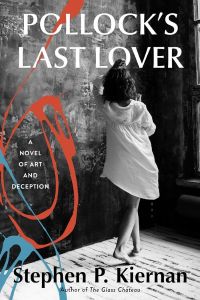
A Novel of Art and Deception – An Engrossing Multigenerational Tale of Ambition, Power, and a Painting Worth Millions
Set in New York City in alternating time periods—the 1950s and the early 2000s—Pollock’s Last Lover is the engrossing tale of two women whose lives collide as they contend with the art and legacy of the brilliant, tragic painter Jackson Pollock.
In 2006, Sotheby’s sells a painting by Jackson Pollock for $140 million—the highest sum ever paid for a work of art. Two weeks later, an older woman named Ruth Kligman, in high heels and a dusty fascinator, contacts a smaller, less prominent auction house to announce that she was Pollock’s lover, and that he gave her his last painting. She declares that it was selfish to keep it in her apartment for fifty years, and that people should see this masterpiece in galleries and museums the world over. The bidding will start at $50 million.
Gwen, an up-and-coming associate at the firm, is assigned the task of verifying the painting’s authenticity. For Gwen, an ambitious woman in a field often dominated by men, it is her biggest project yet. And the company must have absolute certainty. Yet each step of the investigation raises larger questions—about Ruth’s cunning climb in the art world, and even about what caused Pollock’s sudden and violent death.
What follows, in alternating chapters and time periods, is a multigenerational portrait of women’s ambition set against the life and work of Jackson Pollock. From smoky Greenwich Village dive bars to glitzy art auctions, from the empty studio of a man once known for his artistic stamina to the fine museums where his works hang, Ruth’s controversial painting provides a window into two eras—and the ongoing struggle of women to develop power and freedom on their own terms.
Thriller | Mystery | Women's Fiction [ William Morrow, On Sale: May 19, 2026, Hardcover / e-Book / audiobook, ISBN: 9780062878472 / eISBN: 9780062878496 ]

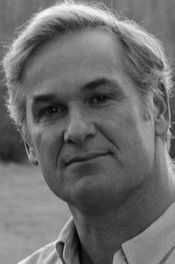
STEPHEN KIERNAN is a writer and journalist for the Burlington Free Press. His numerous awards include the Gerald Loeb Award for Financial Journalism, the Associated Press Managing Editors’ Freedom of Information Award, and the George Polk Award. He lives in Charlotte, Vermont.
No comments posted.







 © 2003-2026