Our new novel, TIME TO BURN – the fourth we have written as a husband-and-wife duo – features the world’s first commercial time-travel company, Tempus Tours, sending groups of the super-rich, the only people who can afford its trips, back to Second World War London.
We alighted on this era partly for the reasons the company’s founder, Inigo Frank, describes in the novel: it is not so far back that any butterfly effect would necessarily be catastrophic, and the time tourists are unlikely to meet themselves. But we also chose it because this is a period of London’s history that has always fascinated us.
We live in the East End of London, a part of the city deeply scarred by the bombs that began falling on 7 September 1940. In fact, every day on the school run, we walk past a plaque commemorating the spot where the first V-1 flying bomb fell on London, on 13 June 1944, on Grove Road, Mile End. Quite often, when we were trying to solve a knotty plot problem – or simply trying to imagine what it would have been like on London’s streets more than eighty years ago – we visited places that helped bring that history to life.
Here are some of the places we discovered along the way.
Ghost Tube Stations
Everyone knows that Londoners sheltered from the air raids on the city in Tube stations, although fewer people know that this did not happen right from the start of the Blitz: it was something Londoners had to fight for. Some stations were also used as offices, either by the government or by the railway and Tube companies.
We were lucky enough to visit Down Street, near Green Park, on a tour with Hidden London. The station closed to passengers in 1932 and was later converted into a secret wartime headquarters for the Railway Executive Committee. It was fascinating to see underground spaces that, having been closed to the public for so long, felt like a time capsule. Hidden London runs regular tours of Down Street and other disused stations and shelters.
St Paul’s and Christ Church Greyfriars
St Paul’s did not sustain catastrophic damage during the Blitz, thanks in large part to the heroic efforts of the St Paul’s Watch, whose firewatchers helped save the building from the worst effects of incendiary bombs. Its iconic dome was felt to be so important to the city’s morale that enormous effort was put into keeping the cathedral safe – Churchill was adamant it must be protected at all costs.
St Paul’s nevertheless suffered two direct hits, in October 1940 and April 1941, as well as damage from numerous incendiaries. The Christopher Wren-designed Christ Church Greyfriars nearby was not so lucky. German bombs destroyed the body of the church in 1940, leaving only its west tower standing. The former nave is now a lovely rose garden where you can sit and eat lunch in the sunshine.
St Dunstan-in-the-East
Another of the city’s great conflagrations, the Great Fire of London of 1666, is commemorated just down the road from this pretty shell of a church. The Monument – which you can climb if you are feeling energetic – stands near Pudding Lane, where the fire began in a baker’s shop.
St Dunstan-in-the-East was rebuilt after the Great Fire, with a tower and steeple designed by Christopher Wren. It was severely damaged again during the Blitz in 1941, although Wren’s tower and steeple survived. The church is exquisite in its decay: vines creep around the mullioned windows, now without their stained glass, and trees grow in the middle of the former nave.
The Palm Tree Pub, Mile End
Perhaps a little niche, but if you want a pint in one of the best-loved traditional boozers in London’s East End, this is your place. Close to the Regent’s Canal and now in the heart of Mile End Park, the current pub was built in 1935 for Truman’s Brewery, replacing an earlier nineteenth-century pub on the site.
It once stood among rows of terraced houses. Much of the surrounding neighbourhood was destroyed or badly damaged by bombing in 1944, and most of what remained was later cleared during post-war redevelopment. The Palm Tree survived both the bombing and the bulldozers and has stood alone since the 1970s.
Bethnal Green Tube Station
The disaster at Bethnal Green Tube station was the worst single loss of civilian life in Britain during the Second World War. The 173 people who died were not killed by a bomb, but in a catastrophic crush as they attempted to enter the station’s shelter.
On 3 March 1943, an air-raid warning sounded and people began making their way down the station steps. Amid confusion and panic, people fell near the bottom of the wet staircase, and the crowd continued to press forward from above, unaware of what was happening in the darkness below. The Stairway to Heaven memorial beside the station now commemorates the 173 people who died: 84 women, 62 children and 27 men.
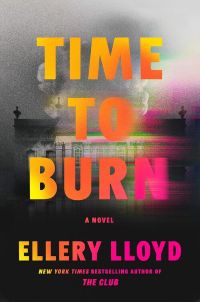
From the New York Times bestselling author of The Club comes a gripping mystery about time travel tourism and the dangerous consequences which ensue when the privileged make the past their playground.
Mercurial tech entrepreneur Inigo Frank has perfected commercial time travel, though it is tightly regulated and so expensive that it’s open only to the very wealthiest.
His company, Tempus Tours, has so far been approved for just one route: a journey back to London in 1941, to the days of the Blitz, allowing the super-rich to experience the awesome sights and sounds of the aerial bombardment of the capital during World War II. It’s a slick operation—routes across the wartime city are meticulously plotted, guides are extensively trained, and rules for the time tourists are strictly enforced.
To immortalize his achievement, Frank enlists award-winning filmmaker Phoebe Hunt to create a fly-on-the-wall documentary. On her first day shadowing Inigo, she is set to witness the return of a billionaire property developer and his family from their trip to the past. But instead of their awe-filled return, she captures the group arriving bloodied and traumatized, with one of their number missing.
Not only that, but Phoebe recognizes the missing woman, and knows not only that she’s not who she claims to be but that she has every reason to harbor a grudge against her. And as events begin to unravel in the present day, it seems increasingly clear that she had sinister motives for returning to the past—and that people close to Phoebe are in danger.
Phoebe must race to untangle the truth—before past and the future are rewritten.
With this inventive, propulsive and genre-bending page turner, the bestselling author of The Club and The Final Act of Juliette Willoughby once again delivers an enthralling tale of legacy and wealth, history and technology with a gripping mystery at its core.
Science Fiction Suspense/Thriller [ Harper, On Sale: August 4, 2026, Hardcover / e-Book, ISBN: 9780063323056 / eISBN: 9780063323070 ]

Ellery Lloyd is the pseudonym for London-based husband-and-wife writing team Collette Lyons and Paul Vlitos. Collette is a journalist and editor, the former content director of Elle (UK) and editorial director at Soho House. She has written for The Guardian, The Telegraph, and the Sunday Times. Paul is the author of two previous novels, Welcome to the Working Week and Every Day is Like Sunday. He is the program director for English Literature with Creative Writing at the University of Surrey.
1 comment posted.











 © 2003-2026